
What Sets Flooring Professionals Apart From Floor Installers
Hiring flooring professionals in Overland Park or Lenexa usually starts the same way: a few names from neighbors, a few from a search, and two or three in-home estimates. By the time the quotes arrive, the floors themselves are often the same product at similar prices. What is not the same is everything that happens before the first plank goes down — the subfloor checks, the moisture readings, the layout plan, the way the floor meets the next room — and who stands behind it if something shows up next summer.
That is hard to see on an estimate, so this guide gives you three ways to see it. Compare the workmanship warranty, not just the product warranty. Find out who will actually be on your floor, and whether they are the same people from job to job. Then ask nine questions that make an installer describe how they would do your rooms. Real craftsmanship answers with tools, numbers and a plan. A fast install answers with reassurance.
If you are still at the stage of checking licenses, insurance and certifications, our guide to choosing a flooring company in Kansas City covers that ground. This one picks up where it ends: you have a short list, the companies all look legitimate, and you need to decide which one gets your house.
Reading the Warranty: Workmanship and Manufacturer Coverage Are Two Different Promises
Most flooring comes with two warranties, and they are easy to confuse. The manufacturer warrants the product: the finish on prefinished hardwood, the wear layer on luxury vinyl plank, the tile itself. The installer warrants the work: how the floor was put down. A long finish warranty does nothing for a hardwood floor that squeaks because it was fastened badly, and a lifetime luxury vinyl warranty does not cover click joints that broke because the plank went down over a dip in the subfloor.
| Warranty | Who stands behind it | What it usually covers |
|---|---|---|
| Workmanship | Your installer | Installation defects: seams opening, fastener squeaks, loose or hollow tiles, failed transitions, trim coming away |
| Hardwood finish | The manufacturer | Wear-through of a prefinished floor’s factory finish under normal use, often for 25 years or more; not scratches, dents or water damage |
| Luxury vinyl wear layer | The manufacturer | Wear-through and manufacturing defects; many quality planks carry lifetime residential coverage when installed to spec |
| Tile | The manufacturer | Defects in the tile itself; terms vary by brand, and setting materials often carry their own separate coverage |
The two are connected in a way most homeowners do not hear about until there is a claim. Manufacturers generally require their product to be installed to their written instructions — subfloor flatness, moisture limits, acclimation, expansion space at the walls — and they decline claims for failures caused by installation. So the installer’s process does double duty. It produces a better floor, and it keeps the product warranty you paid for intact.
What to look for in a workmanship warranty
- It is in writing. A verbal “we stand behind our work” is a sentiment. A written warranty has a length and a scope.
- It names what it covers. Seams, squeaks, hollow tiles, transitions and trim are the usual installation failures. If the document is vague, ask for examples.
- It says who comes back. The best warranty is one where the company you signed with sends someone you have met, not one that refers you to a crew you never spoke to.
- The length fits the risk. Most installation defects show up within the first full cycle of Kansas City seasons — a humid summer and a dry, furnace-heated winter — which is when wood moves most and when a poor bond or a missing expansion gap reveals itself. A one-year warranty covers that window; a much longer promise is only as good as the company’s willingness and ability to honor it.
For reference, every job we do carries the same 1-Year Workmanship Warranty in writing, separate from whatever the manufacturer offers on the product. Our four-step installation process explains how a project runs from the free consultation to the finished floor.
Who Is Actually on Your Floor: Dedicated Crews vs. Rotating Subcontractors
The person who measures your house is often not the person who installs your floor. That is normal. What you want to know is who the installer is, whether they are the same people the company sends every time, and who you call if something is wrong. There are good flooring professionals on both sides of this, so treat it as a question of consistency and accountability rather than a pass-or-fail test.
Dedicated, Consistent Crews
What It Usually Means
- The same installers and project lead work together job after job
- Standards for prep, layout and cleanup are shared habits, not notes on a work order
- The company knows exactly who touched your floor if a warranty call comes in
- Certification is held by the people doing the work, not just the business name
What to Confirm
- Who leads the crew on your job, by name
- Whether that crew has done your material — hardwood, plank or tile — recently
- How full their fall calendar is, and whether that moves your start date
Rotating or Assigned Subcontractors
What It Usually Means
- The seller schedules whichever installer is available for your date
- Some are skilled long-term partners; some you meet for the first time on day one
- Often paid by the job, which rewards speed more than prep
- Common with big-box install programs and some general remodelers
What to Confirm
- Whether you can meet or speak to the installer before the job starts
- Whether prep work — leveling, moisture testing, door undercuts — is in their scope or excluded
- Who handles a warranty claim: the seller, the installer, or neither
Certification is worth asking about by name. The National Wood Flooring Association certifies wood flooring professionals, and the certification belongs to the person, not the company. For tile and luxury vinyl, ask how many similar jobs the lead installer has done in the past year and whether you can see one. At Midwest Flooring Company, the same NWFA-certified crews and the same project leads handle every job, whether it is a white oak living room in Overland Park or a basement in Lenexa — which is the whole point of keeping our service area to five cities within a half-hour of our Prairie Village shop.
Ask Us All Nine Questions in Your Own Home
A free in-home estimate is the right time to put these questions to any installer, including us. We measure every room, check the subfloor and moisture where it matters, and walk you through the layout, transitions and warranty before you decide anything.
Get My Free Estimate9 Questions That Reveal Real Craftsmanship
Credential questions tell you whether a company is legitimate. These tell you whether they are careful. Each one asks the installer to describe how they would do your job, so there is no stock answer to hide behind. Ask the same nine of every company, write down what you hear, and compare.
“How will you check my subfloor for flat, and what tolerance does this product need?”
A good answer names a tool — a long straightedge or a laser — and a number from the manufacturer, usually a fraction of an inch over 6 or 10 feet. It also says what happens if your floor is out: patching the low spots, grinding or sanding the humps, and pricing only the area that needs it. A weak answer is “it looks fine” from the doorway.
“What moisture readings will you take, and what number stops the job?”
Over a concrete basement slab, that means a moisture test before anything goes down. Over a wood subfloor getting hardwood, it means comparing the moisture content of the subfloor and the new flooring with a meter. A good answer includes the limit and what they do when a reading is over it. A weak answer is “the plank is waterproof, so it doesn’t matter” — the plank may be, but moisture trapped under it can still cause odor, mold and adhesive failure.
“Where will the layout start, and where will the narrow rows end up?”
Walls are rarely parallel. A careful installer measures the room first and plans the first and last rows so you do not end up with a one-inch sliver against the most visible wall or at the front door. In tile, the same question decides whether the cut pieces land at the tub or in the middle of the floor. If the answer is “we start at the wall and go,” the layout is being decided by whichever wall is closest.
“How will you handle the doorways and the transitions to my other floors?”
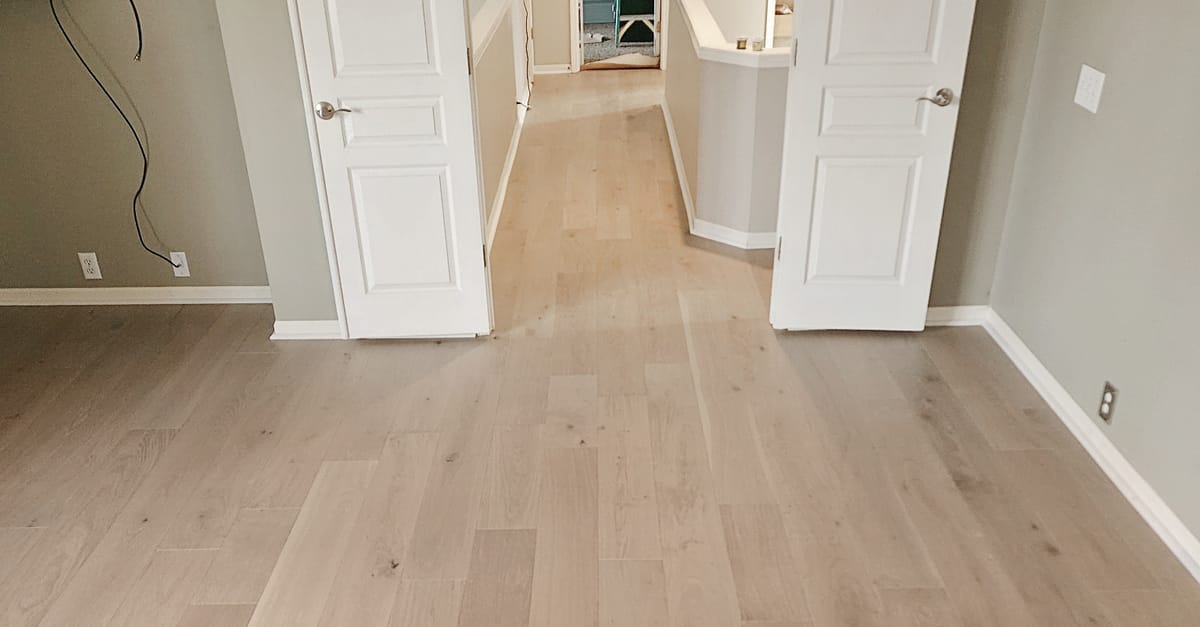
This is where craftsmanship is most visible. Door jambs should be undercut so the floor slides beneath them instead of being caulked around. Where new flooring meets existing hardwood or tile, the heights should be planned in advance. And where the same floor continues from one room to the next — like the oak in the photo above, running through a double doorway with no threshold strip — the rows should carry straight through.
“How long does the material sit in my house before it goes down, and why?”
Hardwood needs to reach a moisture content that suits your house before installation, and many luxury vinyl and engineered products specify a temperature range and a set time in the room. A good answer refers to the specific product’s instructions. A weak answer is a single number for every floor, or none at all.
“What happens at the walls, the cabinets and the island?”
Floating floors need an expansion gap at every wall, hidden by trim, and they cannot be pinned under a heavy island or a run of cabinets. Nail-down hardwood needs its own spacing at the perimeter. Ask how they will finish against cabinets, around a fireplace hearth and along stairs. The answer tells you whether they have done kitchens like yours.
“How do you set tile so it doesn’t sound hollow in two years?”
Hollow-sounding and cracked tiles usually trace back to poor mortar coverage. Industry standards call for at least 80 percent coverage under floor tile in dry areas and 95 percent in wet areas, and large-format tile generally needs back-buttering and the right trowel to get there. A good answer mentions coverage, how they check it and how they keep tile edges level with each other. Our custom tile installation page covers how we approach floors, backsplashes and showers.
“If something shows up in month eight, who comes back, and what do you fix?”
This is the warranty question asked in practical terms. Listen for a named person or role, a rough response time and a clear line between what the installer fixes and what goes to the manufacturer. If the answer involves calling a different company, write that down.
“Can I see a floor you installed a year or more ago?”
A floor on installation day always looks good. A floor after a Kansas City winter shows whether the seams stayed tight, the transitions stayed flat and the finish held up. Ask for an older project in a room similar to yours — a basement if you are doing a basement, a kitchen if you are doing a kitchen — or at least photos and the homeowner’s contact.
You do not need to understand every technical detail in the answers. What you are listening for is specificity. An installer who has done this carefully for years answers question one with a tool and a number and question four with a description of your actual doorways. One who has not tends to say you have nothing to worry about.
What Good Answers Sound Like, Room by Room
The questions that matter shift with the room and the material. Hardwood, luxury vinyl and tile are each the best choice somewhere in a typical Kansas City house, and a careful professional brings up the right details for each room without being asked.
Kitchens
Luxury vinyl and tile shrug off spills; hardwood looks warm and can be refinished, but standing water at the sink and dishwasher needs wiping up. Either way, expect talk about the island, the dishwasher height and the transition into the dining room. More on the trade-offs in our kitchen flooring guide.
Basements
Luxury vinyl plank is the usual answer below grade, and tile works well too; solid hardwood generally does not belong on a slab. Expect a moisture test, a flatness check near floor drains and old wall lines, and a plan for the stair landing.
Homes With Dogs
A thicker luxury vinyl wear layer resists scratches, tile is nearly indifferent to claws, and hardwood will show wear but can be sanded and refinished. A good installer asks about your pets before recommending anything, and talks about sheen, since matte hides scratches better than gloss.
Bathrooms and Laundry Rooms
Tile is the long-term choice where water is a daily fact; luxury vinyl is a solid, budget-friendly option in a powder room or laundry. Listen for waterproofing, the toilet flange height and whether the subfloor under the old floor is sound.
Original Oak Under Carpet
Common in older Overland Park homes. The honest first answer is often refinishing rather than replacing, with new boards woven in where needed. Our guide to hardwood refinishing in Kansas City explains the schedule and finish choices.
Open Main Levels
One floor running through living, dining and kitchen magnifies every layout decision. Expect a plan for plank direction, long runs and where a floating floor may need a break, plus how the floor meets the stairs.
Checking References and Past Work Without Wasting an Afternoon
Reviews tell you how a company treats people. References tell you how its floors age. A five-minute phone call with a past customer is worth more than an hour of scrolling, as long as you ask questions a polite neighbor will answer honestly:
- Did the crew start and finish when they said they would? If not, did someone tell you why before you had to ask?
- Did the price change once the old floor came up? A change is not a red flag on its own — subfloors hide things. What matters is whether it was explained and agreed before the work happened.
- How does the floor look after its first winter? Gaps, squeaks, lifting edges or hollow tiles show up here.
- How was the house left each day? Dust control, protected doorways and a swept floor at the end of the day are habits, and habits carry into the floor itself.
- Did you ever need them to come back? If so, how fast, and was it handled without an argument?
When you look at project photos, skip the wide shots and look at the edges: where the floor meets a door jamb, a fireplace, a stair nose or the next room. That is where shortcuts show. Our recent projects include details like these, and the Westwood hardwood floor extension shows what it looks like when new oak is woven into an existing floor so the seam disappears.
Putting Two or Three Bids Side by Side
Once the estimates arrive, comparing the totals is the easy part. Comparing what each company is actually promising takes a few more minutes. Lay the bids next to each other and check them against the list below. A gap is not automatically bad, but each one is a question to ask before you sign.
| Check for | What a thorough bid shows | Why it matters |
|---|---|---|
| Workmanship warranty | Length and scope, in writing | Separates installation defects from product claims before there is a problem |
| Who installs | Named crew or project lead | Tells you whether the people you met are the people you get |
| Subfloor and moisture | Testing included; prep priced or explained | The most common cause of early floor problems and of mid-job price changes |
| Removal and haul-away | Its own line | Easy to leave out and add back once the job starts |
| Transitions, trim and doorways | Included or itemized | On a house with many doorways, these are real money and real craftsmanship |
| Furniture and appliances | Who moves what | Decides whether install day starts on time |
| Schedule | Start date and expected duration | Fall calendars fill up; a vague start date can slide past the holidays |
If one bid is far below the others, it is usually describing a smaller job, not the same job more cheaply. The usual missing pieces are prep, removal and transitions. Ask the low bidder to price exactly what the others included, and the numbers tend to move closer together. If you are weighing materials as well as installers, our luxury vinyl plank guide explains wear layers and core types so you can compare products on equal terms too.
Local Notes for Overland Park and Lenexa Homes
A good installer knows the houses in your area before walking in, and the homes in these two cities raise different questions.
Overland Park
Overland Park spans decades of construction. Many homes in the northern part of the city date from the 1950s and 1960s and often have original oak under the carpet, where the right flooring professional talks about refinishing, patching and weaving in new boards before suggesting replacement. Farther south, larger two-story homes built since the 1980s bring open main levels, long sightlines and staircases, where layout planning and stair work show skill fastest. Our hardwood flooring page for Overland Park covers both kinds of house.
Lenexa
Much of Lenexa was built after 1980, and many homes have finished or unfinished lower levels on concrete slabs. That makes moisture testing and slab flatness the questions that matter most, and luxury vinyl plank the most common answer. If an installer does not mention the slab before quoting a basement, ask. Our page on luxury vinyl flooring in Lenexa walks through walkout, daylight and full basements.
Both cities share the same seasonal swing: humid summers and dry, furnace-heated winters. Wood floors expand and contract with it, and a crew that understands it plans gaps, acclimation and fastening around it rather than hoping for the best.