
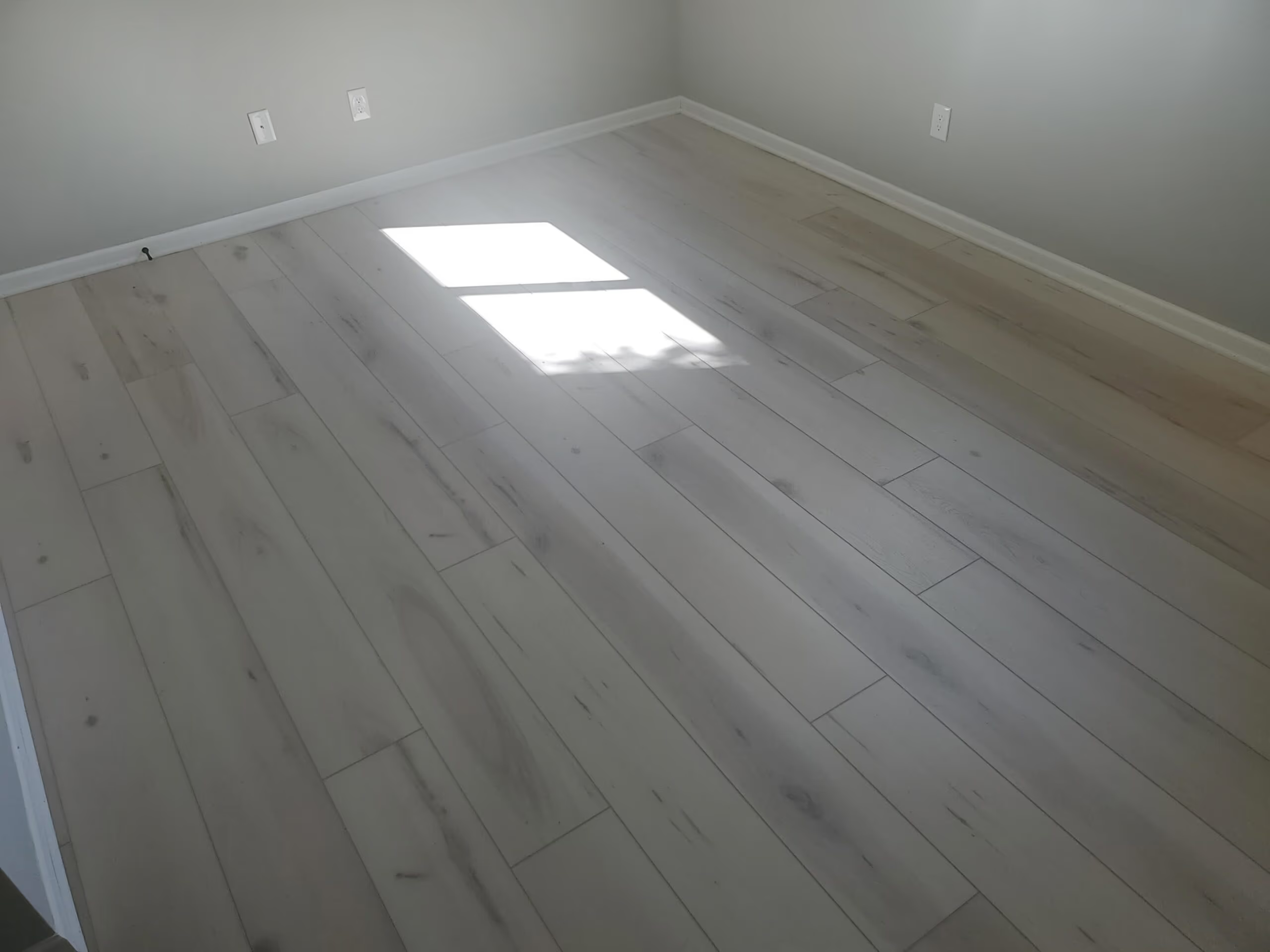
Light whitewashed wide-plank waterproof luxury vinyl flooring installed wall to wall in a lower level in Lenexa, Kansas
Lenexa, Kansas · Luxury Vinyl

Luxury Vinyl Flooring in Lenexa, KS

Lenexa is a city of lower levels, and lower levels are where waterproof plank earns its money. Walkout, daylight and full basements — floored in rigid-core luxury vinyl over a slab we moisture-test and level first, because that is the half of the job that decides whether the floor is still tight in ten years.

Part of our wider luxury vinyl flooring services across the Kansas City area.

Lenexa, KS · lower level
Slab tested, not guessedIn-slab relative humidity readings before we specify anything below grade.
Licensed & insuredLiability and workers’ compensation coverage on every Lenexa job site.
1-Year Workmanship WarrantyOn our labor, alongside the manufacturer warranty on the product you choose.
No showroom markupBuy your own material wherever you like. We quote the installation, not the product.
Why Lenexa is a below-grade city

Almost Everything Here Was Built After 1980

Lenexa had 2,497 residents in 1960. It has 57,434 today, across 25,308 homes and thirty-four square miles — which means the overwhelming majority of this city was built in the era when a finished lower level stopped being a luxury and became a floor plan.

Western Johnson County also happens to be hilly. Builders put those homes into the slope, so Lenexa has an unusually high share of walkout and daylight basements alongside the conventional full ones. Add the regional footing depth — thirty-six inches minimum for frost protection, which makes a basement almost free once you are already digging — and you get a city where the biggest single room in the house is frequently the one underground.

That room is where the flooring problem lives. Solid hardwood is not rated to go there. Carpet traps whatever comes up through the slab. Waterproof rigid-core plank is genuinely the right answer — but only over a slab that has been proven dry and proven flat, and that is a different job from laying plank on a second floor.

So this page is about below grade. If you are flooring the upper levels too, that is the same product and the same crew: see our full luxury vinyl flooring services.

Grey-toned wood-look luxury vinyl plank flooring in a finished lower level with a brick hearth and built-in shelving in Lenexa, Kansas Lenexa, KS
A finished lower level in Lenexa, floored in grey rigid-core plank and back in use as a family room.
Not all basements are the same basement

Three Kinds of Lenexa Lower Level

How much soil is against your walls changes the moisture reading, the temperature and the specification. Here is what each one means for the floor.

Soil against the walls 0ft 8ft Across one level — nothing at the door, everything at the back.

Walkout

One wall opens at ground level onto the yard; the opposite wall is six to eight feet underground. Common on Lenexa’s sloped lots, and the reason this level often feels like a second living room rather than a basement.

What it means: two very different halves of one slab. We test at the door end and the buried end, and specify from the worse of the two readings rather than the average.
Soil against the walls ~4ft On every side — partway up, with the windows above it.

Daylight

Soil sits partway up the walls, so full-height windows sit above grade and the room gets real light — but there is no door out. Effectively a basement with a better view and the same slab underneath.

What it means: still below grade by every standard that matters. Windows change how the room feels, not what the concrete is doing.
Soil against the walls 8ft On every side — to the ceiling, with an egress well the only break.

Full basement

Soil to the ceiling on every side, with an egress window well as the only opening. The coolest and most stable of the three, and the one where summer humidity does the most damage if nothing is controlling it.

What it means: the slab stays near soil temperature year round, so warm August air condenses on it. A dehumidifier is part of the specification, not an accessory.
What survives down there

Which Floors Belong Below Grade

Industry guidance treats a level as below grade whenever the soil outside sits three or more inches above that floor. Walkouts included. That one sentence rules out more materials than most people expect.

Below-grade suitability follows National Wood Flooring Association installation guidance and manufacturer instructions for the products we install.
Material Below grade? Why
Waterproof rigid-core LVP Yes

No wood fibre in the core, so nothing swells. If it ever does get wet, planks lift, the slab dries, and the same planks go back down. This is what we install in most Lenexa lower levels.

Porcelain tile Yes

Impervious and effectively permanent. Colder underfoot, more expensive to install, and it needs the same flat slab — but nothing outlasts it. See our tile services.

Engineered hardwood Conditions

Rated below grade by some manufacturers, but only glued down over a slab that has passed a moisture test, and never in a level that has taken water. We will say plainly whether yours qualifies.

Solid hardwood No

Not rated for below-grade installation at any thickness. If you want real wood down there, engineered is the only version of that conversation. Compare the two.

Carpet No

Holds whatever comes up through the slab and never fully dries. It is the single material we remove most often from Lenexa lower levels, usually with a pad that tells the whole story.

Laminate No

A wood-fibre core with a photograph on top. It swells permanently at the edges once it wets and never recovers. It is not the same product as rigid-core plank, whatever the showroom shelf suggests.

Two minutes, before you call anyone

Read Your Own Lower Level

Six things worth knowing about your basement before you talk to a flooring contractor. Tick anything that applies and we will tell you what it actually means.

Tick what applies

Nothing here rules out a finished lower level. All of it changes the specification — which is why we test rather than assume.

Then the first question is not which floor, it is where the water came from. We look at the grade outside, the downspouts and the sump before talking about material at all. Waterproof plank survives water; it does not stop it arriving.
That is efflorescence — mineral salts left behind as water moves through the concrete and evaporates. It is direct evidence of moisture passing through the wall, and it means the slab reading matters more than usual.
Warm humid air meeting a slab that sits at soil temperature. That is a dew point problem rather than a leak, and a dehumidifier plus the right floor assembly usually settles it. Worth knowing before you blame the floor.
Then it is two rooms in one slab. We test at the door end and at the buried end, because they routinely disagree, and we set the exterior threshold height at the estimate rather than on the last afternoon.
Lift a corner and look at the underside of the pad before you commit to anything. What is on the back of that pad tells us more in ten seconds than a conversation will — and carpet removal runs about $1.25 per square foot including disposal.
Hairline shrinkage cracks are normal in any poured slab and get bridged without drama. A crack with a lip on one side, or one that has clearly moved, needs filling or an uncoupling layer first. We check with a straightedge, not a glance.

Ticked one or more? Good — now you know what to ask about. All six are things we check at the estimate anyway, and all six get priced into the original quote rather than raised as a change order once the carpet is up.

Book a Free Estimate
How a lower level runs

Four Stages, and the Slab Decides Two of Them

Plank goes down quickly. Everything that determines whether it stays tight happens before it.

Free in-home measure and slab test

A project lead, not a salesperson. Every room measured, the slab checked with a straightedge for flatness, and in-slab relative humidity read at more than one point — at both ends of a walkout, always. Thirty to forty-five minutes, evenings and weekends available.

Itemised quote with the prep priced in

Flat rate within 24 hours, broken out: removal and disposal, substrate work, vapour retarder if the reading calls for one, trim and cleanup. We calculate exact material quantities including waste factor and tell you how much to buy, from whichever supplier you like. Published ranges are on our pricing page.

Tear-out, then getting the slab right

Carpet, pad and tack strip out and hauled away. Then the part that costs money and never shows: grinding high spots, patching dips, pouring self-levelling compound where a whole level has moved, and laying a vapour retarder above 75 percent in-slab relative humidity. Self-levelling needs its own cure before anything goes over it.

Install, trim and walkthrough

Material acclimated in the room it will live in, planks pulled from several boxes at once so colour variation reads as natural, expansion gap held at the full perimeter and around every column and pipe. Then base shoe, transitions, a room-by-room sign-off, and the 1-Year Workmanship Warranty starts. See our full four-step process.

Recent work

Three from around the Kansas City area — a walkout that opens at grade, a full basement running through several rooms, and the detail where two floors meet.

Before you book

Lenexa Lower-Level Questions We Get Asked Most

Straight answers to the six that come up on nearly every estimate.

Can luxury vinyl plank go straight onto my Lenexa basement slab?
Onto the slab, yes. Straight onto it, almost never. Rigid-core plank is designed to float over concrete and it does not care about the surface being cold or hard. What it does care about is two things the slab has to be proven on first: moisture and flatness. We run an in-slab relative humidity test rather than taping a square of plastic down and guessing, and above 75 percent a vapour retarder goes in. Then we check flatness with a straightedge, because a floating floor wants to be within roughly three-sixteenths of an inch over ten feet and a 1990s Lenexa basement slab frequently is not. Grinding, patching or self-levelling compound closes that gap. Skip either step and the floor still goes down fine — it just fails eighteen months later at the lock joints.
Our lower level has taken water before. Is waterproof flooring enough?
No, and anyone who tells you otherwise is selling flooring rather than solving your problem. Waterproof plank means the plank survives water — it does not mean water stops arriving. If your lower level has flooded, the fix starts outside: grade sloping away from the foundation, downspouts discharging well clear of the wall, and a sump that works. Once water is controlled, rigid-core plank is genuinely the best finished floor available down there, because if it ever does get wet again the planks can be lifted, the slab dried, and the same planks put back. Carpet in that situation is a write-off every time. We will tell you at the estimate if we think you have a water problem rather than a flooring problem.
We have a walkout basement. Does the whole level get the same floor?
Usually yes, but it gets tested twice. A walkout is really two rooms in one: the door wall is at grade with sunlight on it, and the back wall is six to eight feet underground against cold soil. Those two ends of the same slab routinely give different moisture readings and different temperatures, so we test at both. In practice the floor specification is driven by the worst reading, not the average. The other walkout-specific detail is the threshold at the exterior door, where the finished floor height has to work with the door sweep and the exterior grade — we set that at the estimate rather than discovering it on the last afternoon.
What does a Lenexa lower level cost to floor?
Installation starts at $2.99 per square foot and material typically runs $2.99 to $8, bought by you from whichever supplier you like because we do not run a showroom or mark up product. On a below-grade job the number that actually moves is preparation. Carpet, pad and tack strip removal runs about $1.25 per square foot including disposal. Substrate work ranges from $2 to $25 per square foot depending on whether we are patching a few low spots or pouring self-levelling compound across a whole lower level, and a vapour retarder is priced in when the moisture test calls for one. We measure and test at the estimate so that prep is a line in your original quote rather than a change order once the carpet is up.
Will a basement floor be cold? Do we need underlayment or heat?
Cooler than the floor above it, always — you are standing on concrete that is in contact with soil at about fifty-five degrees year round. Rigid-core plank with an attached pad takes the edge off and removes the hollow click that a bare floating floor over concrete produces. What it will not do is insulate, and doubling up a second pad underneath does not help; it makes the floor spongy and voids most manufacturer warranties. If genuine warmth matters, the options are electric mat under tile or a properly detailed insulated subfloor panel system under the plank, and both are decisions to make before the quote rather than after. A dehumidifier does more for comfort down there than most people expect.
How long does it take, and do we have to empty the lower level?
A typical Lenexa lower level is two to four days on site once the material has acclimated, and longer if self-levelling compound is involved because it needs its own cure before anything goes over it. The space does need to be clear — furniture, storage and anything against the walls, because the expansion gap runs the full perimeter. We can move furniture at $50 per item or bring in a moving service starting at $800 for a full-home project, and we will tell you which is cheaper for your situation. The rest of the house stays usable throughout, and we clean up at the end of every day rather than the end of the job.

Get a Free Lower-Level Estimate in Lenexa

Tell us the rooms, the address and roughly what you have in mind. We will measure, test the slab at more than one point, and send an itemised flat-rate quote within 24 hours — with no obligation attached to any of it.

Licensed and insured · Slab tested before we start · 1-Year Workmanship Warranty

Sources

Lenexa population counts, housing unit total and land area: U.S. Census Bureau decennial censuses, 1960 through 2020. Below-grade definition — any level where the surrounding soil sits three or more inches above the floor — substrate flatness tolerances and material suitability: National Wood Flooring Association Installation Guidelines. In-slab relative humidity testing and the 75 percent threshold for vapour retarders: ASTM F2170 in-situ probe testing and manufacturer installation instructions. Frost-depth footing requirement: Johnson County residential foundation guideline. Per-square-foot pricing ranges: our own published pricing.