Finished basement
Below grade, solid hardwood is not rated to live there and carpet is a moisture problem waiting to happen. Waterproof rigid core over a tested, levelled slab is the answer — and it is the single most requested job we run in Olathe.

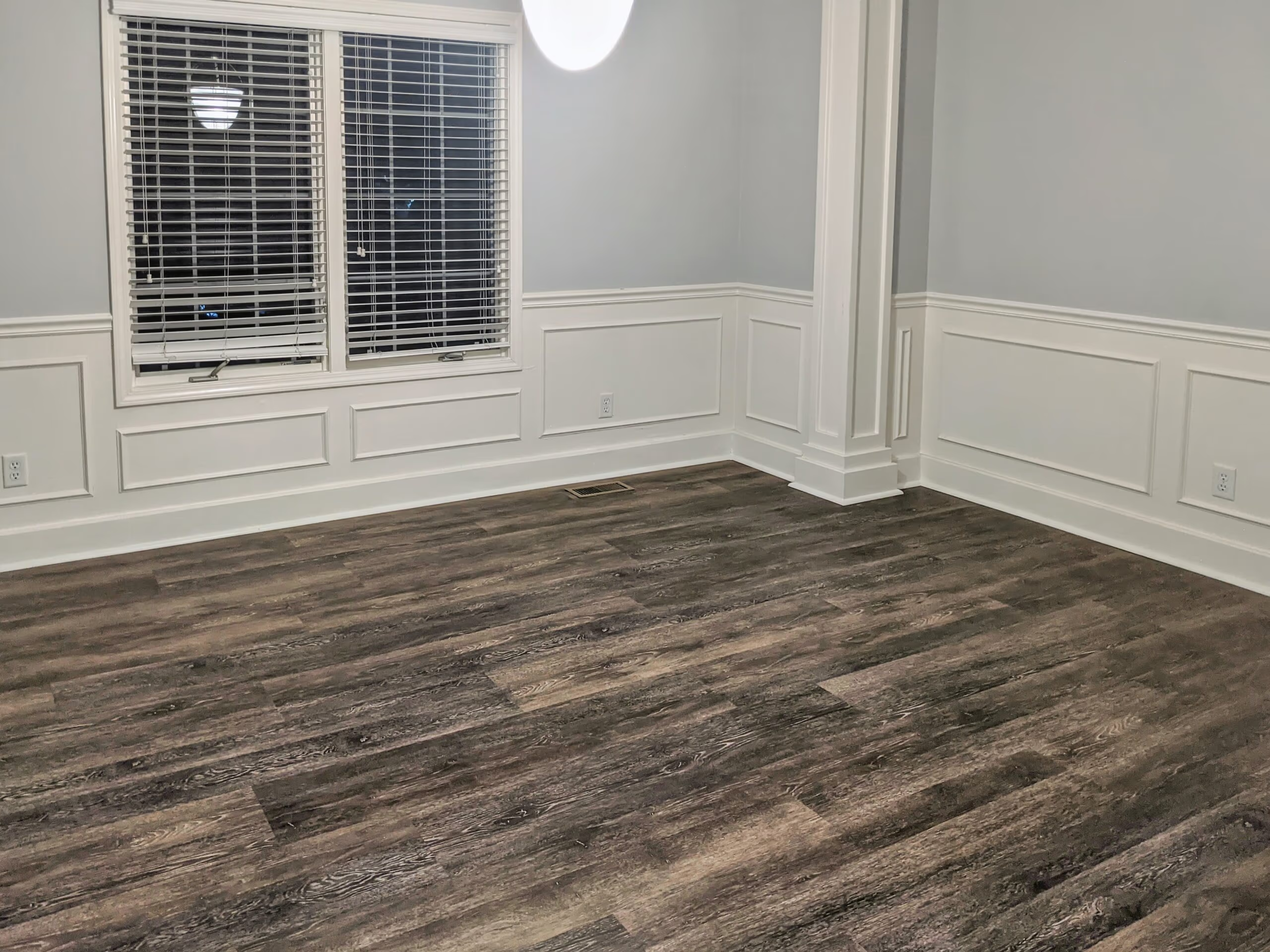
Waterproof rigid-core plank and tile, installed over a slab we have actually tested. Finished basements, kitchens, mudrooms and whole main levels — the floor that handles a Kansas basement, a dishwasher line and a large dog without complaint. Flat-rate quote within 24 hours, one project lead start to finish.
Part of our wider luxury vinyl flooring services across the Kansas City area.
Olathe went from 92,962 people in 2000 to 141,290 in 2020, and it built roughly 51,800 homes to hold them. That makes it the newest housing stock we work in — and the one where waterproof plank is most often the right answer rather than a compromise.
Newer construction here means big finished lower levels, slab-on-grade rooms off the garage, and open main levels that run uninterrupted from the front door to the back wall. Those are exactly the conditions where solid hardwood is either not rated to go or not worth the risk, and where a rigid-core plank quietly outperforms everything else.
It is also a city of young families. Luxury vinyl plank is the floor people choose when the honest requirement is not “heirloom” but “survives a Labrador, a potty-training toddler and an ice maker that will eventually leak.” It does that, and modern wide-plank product looks far better than the vinyl anyone remembers from twenty years ago.
What it does not do is forgive a bad substrate. That is the part of this job worth paying for, and it is where most of our Olathe work actually goes: see our full luxury vinyl flooring services, or read on for what we check before anything gets laid.

Every luxury vinyl floor is five layers, and only one of them is what salespeople talk about. Tap a layer to see what it actually does — and which number is worth spending money on.
A clear urethane skin over the printed film. This is the only number that decides how long the floor keeps looking new, and it has nothing to do with the plank’s overall thickness — an 8 mm plank with a 6 mil wear layer will scuff long before a 5 mm plank with 20 mil on top.
A mil is a thousandth of an inch. It gets confused with millimetres constantly, including on spec sheets, and that confusion is how people end up with rental-grade product in a family room.
A high-resolution photograph of wood or stone, pressed under the wear layer and then embossed so the texture you feel lines up with the grain you see. Registered emboss — where the two actually match — is the difference between a floor people compliment and a floor people identify from the doorway.
The other tell is repeat. Budget product may carry only six or eight unique plank images in the whole run, which reads as an obvious pattern across a large Olathe great room. Better product carries twenty or more.
SPC is stone-plastic composite: denser, thinner, harder underfoot, and the most dimensionally stable option when a room swings a long way in temperature. It is what we specify for basements, sunrooms and anywhere with a lot of glass.
WPC is wood-plastic composite: thicker, warmer, quieter, and a little more forgiving over a substrate that is not perfectly flat. It suits bedrooms, living areas and upper floors.
Neither contains wood fibre that can swell, which is why standing water on the surface does nothing to the plank itself.
A thin pad bonded to the back of the plank. It takes the hollow click out of a floating floor over concrete, adds a little warmth underfoot, and saves the separate roll-out underlayment step.
What it does not do is fix a floor that is out of flat. An attached pad is roughly a millimetre thick; it will bridge a sanding scratch, not a quarter-inch dip in a basement slab.
Rigid core telegraphs a bad substrate in a way carpet never did. Every hump becomes a hollow spot underfoot, and every hollow spot eventually becomes a cracked lock joint that has to be taken apart to fix.
Below grade there is a second problem you cannot see. A waterproof floor over a wet slab does not stop the moisture — it traps it, and you get odour and mould under a floor that looks perfect from above. Industry guidance calls for a vapour retarder whenever an in-slab relative humidity test reads above 75 percent, and the only way to know is to test.
Luxury vinyl is the right floor for most of a house and the wrong floor for a couple of rooms. Here is where we put it, and where we will tell you to do something else.
Below grade, solid hardwood is not rated to live there and carpet is a moisture problem waiting to happen. Waterproof rigid core over a tested, levelled slab is the answer — and it is the single most requested job we run in Olathe.
Dishwasher lines, ice makers and a refrigerator that will eventually leak. The plank does not care, and a damaged board can be lifted and swapped without sanding and refinishing an entire room to match.
Snow melt, road salt, wet dogs and a washer hose with a finite lifespan. Specify a 20 mil wear layer in these rooms even when the rest of the house is 12 — the cost difference over a mudroom is trivial.
Quiet and warm underfoot with an attached pad, no refinishing cycle ever, and wide-plank product that photographs like real wood. This is the whole-floor job that has largely replaced carpet in newer Olathe homes.
Waterproof through the plank, but the perimeter and the toilet flange still have to be detailed properly or water finds the gap. For a primary bathroom being fully remodelled, tile is often the better long-term call.
A room that swings from 15°F to 100°F is the one place rigid core can genuinely move. If the space is not conditioned year round we will size the expansion gap for it, specify SPC over WPC, or tell you honestly that tile is the safer floor.
Not sure which category your project falls into? That is what the free estimate is for — and we will tell you when the answer is a different material, including when it costs us the bigger job.
A project lead comes out, measures every room, checks the slab for moisture and flat, and sends an itemised quote that separates labour, prep, trim and cleanup. Free, in your home, and no obligation attached to any of it.
Luxury vinyl goes down quickly. What takes the time — and what decides whether the floor is still tight in ten years — happens before the first plank clicks together.
Six things that happen on every Olathe job before a box is opened. All of it is priced from what we find at the estimate.
A project lead, not a salesperson. Rooms measured, slab tested, substrate checked, and a straight conversation about wear layer and core for each space. Thirty to forty-five minutes.
Flat rate within 24 hours, with prep priced from what we found. We calculate exact quantities including waste factor and tell you how much to buy, from whichever supplier you prefer.
Carpet, pad and tack strip out and hauled away, substrate brought right, then the floor goes in. Two to four days on a typical Olathe basement or main level, cleaned up at the end of every day.
Base shoe or quarter round over the expansion gap, transitions set, furniture back, then a room-by-room sign-off. The balance is due only when you are satisfied, and the 1-Year Workmanship Warranty starts here. See our full four-step process.
Three from around the Kansas City area — a lower level, a main-level dining room, and a floor carried through a doorway without a threshold.


Straight answers to the six that come up on nearly every estimate.
The detail behind the decisions that come up most often in Olathe homes.
Tell us the rooms, the address and roughly what you have in mind. We will measure, test the slab, and send an itemised flat-rate quote within 24 hours — with no obligation attached to any of it.
Licensed and insured · Slab tested before we start · 1-Year Workmanship Warranty
Olathe population counts and housing unit totals: U.S. Census Bureau decennial censuses, 2000, 2010 and 2020. Below-grade definitions, substrate flatness tolerances and the guidance that flooring does not stiffen or correct a subfloor: National Wood Flooring Association Installation Guidelines. In-slab relative humidity threshold for vapour retarders: ASTM F2170 in-situ probe testing and manufacturer installation instructions. Per-square-foot pricing ranges: our own published pricing. Wear layer, core and emboss specifications follow the manufacturer data sheets for the products we install.