
The Short Answer, Then the Line Items
In the Kansas City metro, a finished luxury vinyl plank floor typically lands between $5 and $12 per square foot, plank and labor together. Our installation labor runs $2.99 to $5.00 per square foot, including underlayment on planks thicker than 4mm, and the plank itself runs roughly $2.99 to $8 per square foot depending on what you pick. On 1,000 square feet, that is about $5,000 to $12,000 for the floor.
That range is honest, but it describes a floor going down into an empty room over a flat, dry subfloor. Most houses are not that room. The carpet has to come out, there is a dip by the patio door, the basement stairs are carpeted, and the living room meets an oak hallway. Those are the lines that separate a $6-a-foot job from a $13-a-foot one, and they are the same lines whoever you hire. Here is the whole quote, laid out the way we build one.
| Line item | Typical range | What moves it |
|---|---|---|
| Installation labor, floating | $2.99–$5.00 / sq ft | Layout complexity; underlayment included on planks thicker than 4mm |
| Installation labor, glue-down or thin plank | $3–$5 / sq ft | Thinner dryback or felt-backed product, adhesive, stricter flatness |
| The plank | $2.99–$8 / sq ft | Core type, wear layer thickness, brand; buy 5–10% extra for cuts |
| Carpet removal and haul-away | ~$1.25 / sq ft | Glued-down floors and tile take more work and are quoted on sight |
| Subfloor repair and leveling | $2–$25 / sq ft | Charged only on the areas that need it, not the whole room |
| Stairs | Per step | Nosing style, open sides, landings, what is on them now |
| Quarter round or base shoe | $0.54–$3.84 / linear ft | Profile, material, painted or prefinished |
| Transitions between rooms | Included | Confirm the same on any other quote before comparing totals |
| Furniture moving | $50 / item, or from $800 full service | Free if the room is empty when the crew arrives |
| Complex layouts | +7–15% | Islands, angles, closets, diagonal or patterned layouts |
Two things that table does not show. Very small rooms, under about 100 square feet, can carry a minimum charge, because a crew still has to load up, drive out and set up for a powder room. And the largest swing is almost never the plank or the labor rate. It is prep: the removal and leveling lines are the ones with the widest ranges, and they are the ones nobody can price honestly until the old floor is up or at least looked at.
Floating vs. Glue-Down: The Method Sets the Labor Line
Luxury vinyl goes down one of two ways, and the method you need is decided mostly by the room, not by preference. It changes the labor rate a little and the prep requirement a lot.
Floating Click-Lock
Where It Fits
- Most living areas, bedrooms, basements and kitchens in a typical house
- Rigid-core plank that locks edge to edge and rests on an underlayment
- Walkable and furnishable as soon as the crew finishes
- More forgiving of minor subfloor imperfections than glue-down
- Labor from $2.99 / sq ft, underlayment included on 4mm+ plank
What to Plan For
- Needs an expansion gap at every wall, hidden by trim
- Cannot be pinned under cabinets or a heavy island
- Very long runs may need a break at a doorway
- A slightly hollow sound underfoot compared with glued plank
Glue-Down
Where It Fits
- Large open areas that would otherwise need expansion breaks
- Sunrooms and rooms with big temperature swings
- Stairs, where every tread and riser is glued regardless
- Rolling loads, such as an office chair zone
- Thinner plank keeps floor heights down against an adjoining room
What to Plan For
- Stricter flatness, so leveling is more likely to appear on the quote
- Adhesive needs about 24 hours before heavy furniture
- Harder and costlier to remove later
- Labor typically $3–$5 / sq ft for thinner or felt-backed plank
Does luxury vinyl need to be glued down? Usually not. The rigid-core click-lock plank that fills most showrooms is designed to float, and gluing a floating product can void its warranty. Glue-down is its own product category, and the choice follows the manufacturer’s instructions for the specific plank. In practice, the method matters for cost less through the labor rate — the two ranges overlap — than through prep. A glue-down floor telegraphs every hump in the subfloor, so the flatness bar is higher and the leveling line is more likely to be more than zero.
Our page on luxury vinyl plank flooring installation in Kansas City covers the construction differences, core types and wear layers, in more depth if you are still choosing a product.
Removing the Old Floor: Cheap to Pull, Expensive to Chip
What is on the floor now is the first thing that moves the quote, and it moves it by a lot more than most people expect.
Carpet and pad
The easy one. Removal and haul-away averages about $1.25 per square foot, and that includes pulling tack strip and staples so the plank has a clean surface. On a 600-square-foot basement, that is about $750. It is also the most DIY-friendly line on any flooring quote, if you have a truck and a free Saturday.
Glued-down vinyl, laminate or engineered wood
Laminate and floating floors come up quickly. Anything glued down is slower, because the adhesive residue has to come off or be covered before new plank goes down, and a glue-down floor needs a cleaner surface than a floating one. We quote these after seeing them, because two kitchens with the same sheet vinyl can take very different amounts of scraping.
Ceramic tile
The heavy one: chipping tile and the mortar bed under it is loud, dusty, slow work, and the surface underneath usually needs patching afterward. Sometimes floating plank can go over existing tile that is flat, solid and well bonded, with the grout lines filled, if the plank manufacturer allows it. That can remove the demolition line completely, at the cost of raising the floor height, which matters at doorways and appliances.
Older resilient flooring
A caution rather than a price. Sheet vinyl and 9-inch tiles from before about 1980, and some of the black adhesives under them, can contain asbestos. In older Prairie Village and Overland Park houses it is worth having that tested before anyone scrapes it. If it tests positive, the usual choices are licensed abatement or covering it in place, which is one of the situations where floating plank earns its keep.
Subfloor Prep and Leveling: The Widest Range on the Quote
Subfloor repair and leveling runs $2 to $25 per square foot, and that range is wide on purpose. At the bottom it is a bag of patch feathered into a low spot by the patio door. At the top it is replacing a water-damaged section of plywood under a bathroom, or pouring self-leveler across a slab that falls an inch toward the drain. The important detail is that it is charged only on the areas that need it. A 700-square-foot living area with two 30-square-foot dips is leveling 60 square feet, not 700.
Why it matters so much with vinyl: plank is thin, and it follows whatever it sits on. Most rigid-core manufacturers specify flatness in the range of 3/16 inch over 10 feet, and glue-down products are usually stricter. Over a hump, click joints flex every time someone walks across and eventually break or peak; over a dip, the floor feels soft and the seam opens. The plank is not defective. It was installed over a surface it was never rated for.
What we look for in Kansas City houses
- Basement slabs. Common across Olathe, Lenexa and Shawnee, and the reason luxury vinyl is so popular below grade. Slabs are rarely flat near floor drains and old wall lines, and they need a moisture reading before anything goes down. Our guide to waterproof flooring for Kansas City basements covers the moisture side in detail.
- Mid-century plank or plywood subfloors. In older ranches and split-levels, loose boards squeak and flex. Screwing them down is cheap prep that belongs on the quote and prevents a noisy new floor.
- Transitions to existing hardwood or tile. If the new vinyl will sit next to an existing floor, the heights have to work, which can mean an underlayment choice or a thinner plank rather than more leveling.
- Past water damage. Under dishwashers, toilets and laundry rooms. Soft or stained plywood gets replaced, not covered.
This is the line to ask about directly. A quote with no prep line either assumes a perfect subfloor or has quietly excluded it. Ask what the price assumes, and what happens to the number if the assumption is wrong once the carpet is up.
Want Your Quote Broken Out Line by Line?
A free in-home estimate is where the ranges on this page turn into your numbers. We measure every room, check flatness and moisture where it matters, look at what is under the current floor, and write the quote with installation, removal, prep, stairs and trim as separate lines, so you can see exactly where the money goes.
Get My Free EstimateStairs: Priced Per Step, Not Per Square Foot
Stairs are the line that surprises people most, because a 13-step staircase is only about 40 square feet of material and takes longer to install than a bedroom. Every tread and riser is measured, cut and glued individually, and each step gets a stair nose along the front edge. That is why stairs are quoted per step. For planning, cost guides put vinyl stair installation roughly in the $50 to $150 per step range for labor, before the treads, risers and nosing themselves. We price stairs after seeing them, and these are the things that decide where in the range they fall:
- What is on them now. Carpet with tack strip and hundreds of staples takes longer to strip than bare treads.
- The nose. A tread with a rounded overhang (a bullnose) either gets trimmed flush or covered with an overlapping stair nose. Trimming is extra labor; overlapping changes the look and the tread depth slightly.
- Risers. Plank on the risers too, or painted risers for contrast. Painted white risers with vinyl treads are common and slightly cheaper.
- Open sides, landings and winders. An open side needs a finished return on every step, and pie-shaped winder steps are slow. A straight, closed basement stair is the simplest case.
One budget-aware choice: if the main level is getting vinyl and the basement stair is carpeted and in decent shape, leaving the stair for a second phase is a legitimate way to spread the cost. The transition at the top step is handled either way. If the stairs connect two hardwood floors, our article on hardwood stairs in Kansas City covers the wood side of the same decision.
Trim, Transitions and the Small Lines That Add Up
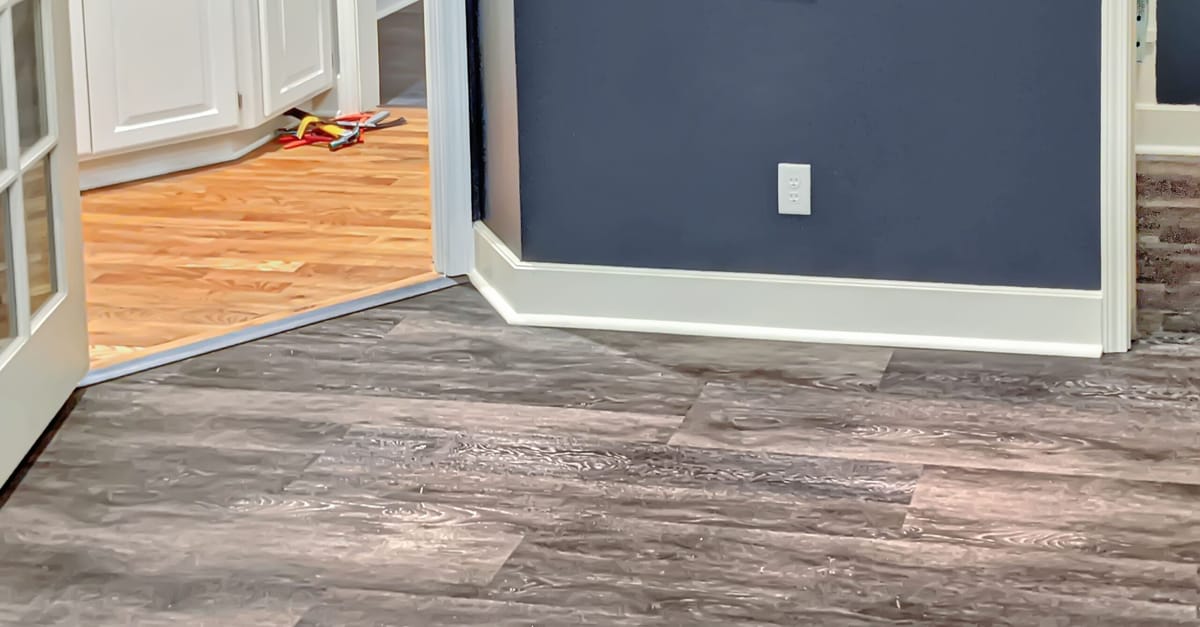
A floating floor needs a gap at every wall so it can move with temperature, and something has to cover that gap. Usually that is quarter round or base shoe, at $0.54 to $3.84 per linear foot depending on the profile and whether it is painted or prefinished to match. A 12-by-14 bedroom has roughly 50 linear feet of wall once you subtract the door; an open main level can easily have 200. If your existing baseboards are coming off and being replaced anyway, the new baseboard can sometimes cover the gap on its own.
Transitions — the strips where vinyl meets tile, hardwood or carpet at a doorway — are included in our pricing. They are worth checking on every quote you compare, because on a house with six doorways they are real money if they are billed separately.
The remaining small lines are mostly about what is in the way. Furniture moving is $50 per item, or full-service removal and replacement starting at $800 for a whole floor. Toilets and appliances are pulled and reset as needed so the plank runs under them properly rather than stopping at their edges. Complex layouts — a kitchen island, a lot of closets, angled walls, a diagonal lay — add roughly 7 to 15 percent, because they mean more cuts and more waste.
The Plank Itself: Where You Choose the Number
We install material bought from any major supplier, including Floor & Decor, Home Depot, Lowe’s and LL Flooring, so the plank is the line where you are in full control. It runs roughly $2.99 to $8 per square foot, and the spread tracks three things:
- Wear layer. The clear protective layer over the printed design, measured in mils. It is the single best predictor of how the floor looks in five years. A 12 mil wear layer is a sensible floor for bedrooms and a quiet household; with dogs, kids and a busy kitchen, 20 mil is money well spent.
- Core. Stone-plastic (SPC) cores are dense and dent-resistant; wood-plastic (WPC) cores are a little softer and warmer underfoot. Both are waterproof plank.
- Attached pad and thickness. A plank with a pad already attached should not get a second underlayment under it. A thicker plank feels more solid but raises the floor at transitions.
Order 5 to 10 percent more than the measured square footage for cuts and waste, toward the high end for small rooms, closets and diagonal layouts. We tell you exactly how much to order and coordinate delivery with the install date. Keep a box after the job: a damaged plank years from now is a simple swap only if you have a matching one.
Three Kansas City Quotes, Worked Out
Ranges are easier to believe with arithmetic attached. Below are three common projects priced with the numbers above. They are illustrations, not quotes — your rooms will measure differently — but they show which lines actually move the total.
A finished basement in Olathe: 600 sq ft, floating, over a slab
Carpet out, moisture reading on the slab, two low spots near the floor drain to level, then rigid-core plank floated over the concrete.
| Line | Basis | Range |
|---|---|---|
| Plank | ~640 sq ft with waste at $3–$5 | $1,920–$3,200 |
| Installation labor | 600 sq ft at $2.99–$5.00 | $1,794–$3,000 |
| Carpet removal and haul-away | 600 sq ft at ~$1.25 | ~$750 |
| Leveling | ~60 sq ft at $2–$25 | $120–$1,500 |
| Quarter round | ~110 linear ft at $0.54–$3.84 | $60–$420 |
| Total | Transitions included | ~$4,650–$8,870 |
That works out to roughly $7.75 to $14.80 per square foot all in — above the $5 to $12 headline, because removal and leveling are real work that the headline range does not include. The biggest single lever here is the leveling line, which is why the slab gets looked at before the number is final.
A kitchen in Overland Park: 220 sq ft, floating over existing sheet vinyl
The old sheet vinyl is a single layer, flat and well bonded, and the chosen plank’s manufacturer allows installation over it, so it stays. The island and a long run of cabinets make it a complex layout.
| Line | Basis | Range |
|---|---|---|
| Plank | ~240 sq ft with waste at $3–$5 | $720–$1,200 |
| Installation labor | 220 sq ft at $2.99–$5.00 | $658–$1,100 |
| Complex layout | +7–15% on labor | $46–$165 |
| Removal | Covered in place | $0 |
| Base shoe at cabinets and walls | ~60 linear ft at $0.54–$3.84 | $32–$230 |
| Total | Appliances pulled and reset as needed | ~$1,456–$2,695 |
The decision that saved money here was not a cheaper plank. It was skipping demolition. The trade-off is floor height: the new floor sits higher at the dishwasher and at the transition into the next room, which has to be checked before ordering, not after. Kitchens are also where the floating rule matters most — the floor runs under the dishwasher and range but stops at the cabinet bases and the island rather than being pinned under them.
A main level with dogs in Shawnee: 800 sq ft plus a 13-step stair
Living room, dining room and hallway coming out of carpet, a 20 mil wear layer for two large dogs, and the carpeted basement stair converted to match.
| Line | Basis | Range |
|---|---|---|
| Plank | ~860 sq ft with waste at $4–$6 | $3,440–$5,160 |
| Installation labor | 800 sq ft at $2.99–$5.00 | $2,392–$4,000 |
| Carpet removal and haul-away | 800 sq ft at ~$1.25 | ~$1,000 |
| Leveling | ~40 sq ft at $2–$25 | $80–$1,000 |
| Quarter round | ~200 linear ft at $0.54–$3.84 | $108–$768 |
| Furniture moving | 10 pieces at $50 | $500 |
| Stair labor | 13 steps at ~$50–$150 | $650–$1,950 |
| Total | Plus stair nosing and tread material | ~$8,170–$14,378 |
Notice where the flexibility is. Moving the furniture yourself takes $500 off. Leaving the stair for later takes off up to $1,950 plus its material. Choosing a 12 mil plank instead of 20 mil would save money too, but with two large dogs it is the one line we would not cut: the wear layer is what the dogs are actually walking on. If you are weighing vinyl against wood for rooms like these, our room-by-room comparison of luxury vinyl and hardwood runs the long-term numbers for both.
Doing Part of It Yourself: Where DIY Saves and Where It Costs
Can you install luxury vinyl yourself? In a simple rectangular room over a flat, dry subfloor, yes — click-lock plank was designed to make that possible, and plenty of homeowners do a good job of a bedroom. The trouble starts with the complications this whole article is about: a subfloor that is out of flat, an untested slab, a kitchen full of cabinets, doorways, and stairs. That is also where most failed floors we are called to look at come from.
Asked what the most common vinyl plank installation mistakes are, these are the ten we see most:
Skipping the flatness check
A straightedge and ten minutes would have found the hump that is now breaking click joints.
No moisture test on the slab
Waterproof plank does not stop moisture coming up from below; trapped under the floor, it can lead to mold and odor.
No expansion gap at the walls
A floating floor pressed tight to the drywall buckles in the first hot week of summer.
Pinning the floor under cabinets or an island
A floating floor has to float. Anchor it and it separates somewhere else.
Nailing trim through the floor
Quarter round is nailed into the baseboard, never down through the plank.
Poor end-joint stagger
Joints too close together, or in a repeating stair-step, weaken the floor and look wrong from across the room.
Working from one box at a time
Mixing planks from several boxes spreads out color variation and pattern repeats.
Doubling up underlayment
A second pad under a plank that already has one makes the joints flex and fail.
Not undercutting door jambs
The plank should slide under the casing. Otherwise you get a caulked gap or a pinched board.
Ignoring acclimation and temperature limits
Manufacturers specify a temperature range and sometimes a waiting period. Following them is also what keeps the warranty intact.
The DIY that reliably saves money without risking the floor is everything before the install: pulling and hauling the carpet (about $1.25 a square foot), emptying the rooms ($50 a piece), and taking the doors off their hinges. Leave the leveling, the stairs and the cabinet cuts to a crew. Ours are NWFA certified, licensed and insured, and every job carries a 1-Year Workmanship Warranty, which is the part of a professional install you cannot buy at the store.
If You Are Also Pricing Hardwood
Plenty of Kansas City homeowners price both floors before deciding, often hardwood for the main living areas and vinyl for the basement and bedrooms. The prep lines above — removal, leveling, trim — cost the same under either floor. The difference is almost all in the material and finishing.
Hardwood runs roughly $14 to $32 per square foot installed and finished, so 1,000 square feet is about $14,000 to $32,000, against roughly $5,000 to $12,000 for luxury vinyl. Installation labor alone is $3 to $6 per square foot. Hardwood also has a timing cost vinyl does not: a floor sanded and finished on site needs days before furniture goes back, where a floating vinyl floor can be furnished the same afternoon. Our full breakdown of what hardwood floor installation costs per square foot in Kansas City covers the wood side line by line.
Neither is the wrong answer. Hardwood can be refinished for decades and suits the main rooms of many older Prairie Village houses; luxury vinyl is the stronger choice below grade, in busy kitchens and wherever water and pets are daily facts. Midwest Flooring Company installs both, along with custom tile, so the recommendation follows the room rather than whatever we happen to sell.