
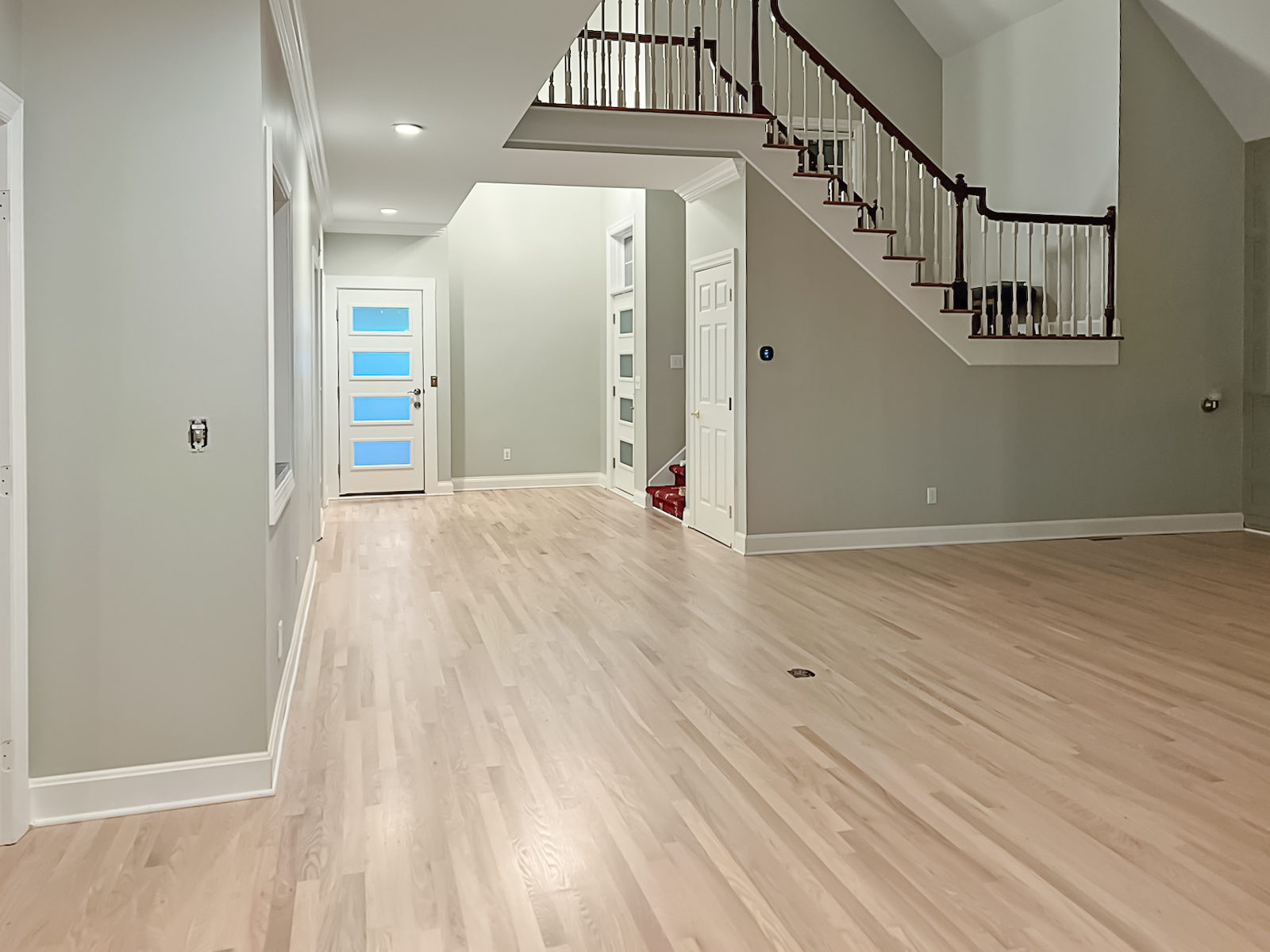
Your Floors Had Oak Under the Carpet. Your Stairs Probably Don't.
Most conversations about hardwood stairs in Kansas City start the same way. A homeowner in Prairie Village or Overland Park has just had the main level done, it looks exactly like they hoped, and then there is a carpeted staircase sitting between two beautiful floors like a piece of the old house nobody removed.
The reasonable next thought is: there was oak under the living room carpet, so there is probably oak under the stair carpet too. Usually there is not — and that one fact explains most of what follows, including why two contractors can quote the same staircase very differently.
Builders finished what was going to show. The typical Prairie Village house dates to the late 1950s: oak floors, because oak floors were the standard, and stairs framed to be carpeted from day one. What is under that carpet is usually construction-grade lumber — a square-edged board with no nosing profile, often cupped or sloped from decades of use, with staple holes and tack-strip damage down both ends. It was never meant to be looked at.
| When the house was built | What's usually under the carpet | What that means for you |
|---|---|---|
| Pre-1940 Older pockets of Shawnee and eastern Overland Park |
Often genuine oak or fir treads — sometimes finished only in a strip down the middle where a runner sat | Worth checking before you buy anything |
| 1945–1975 Prairie Village, eastern Shawnee, north Overland Park |
Construction-grade tread stock with pine or plywood risers, carpeted from new | Plan on new treads, not refinishing |
| 1975–2000 South Overland Park, Lenexa, Shawnee, Olathe |
Plywood or fingerjointed treads and risers, frequently with squeaks already developed | New treads plus squeak repair |
| 2000 and newer | Engineered stringers with plywood treads; some builder upgrades included real oak | Check the builder's spec sheet first |
There is a cheap way to settle it before you talk to anyone. Lift a corner of the carpet on the top step — the least visible one — and look at the front edge of the tread. A finished oak tread has a rounded or eased edge that overhangs the riser below. Construction-grade stock is square, unfinished, and often shows a seam where two boards were joined. That thirty-second check tells you which of the three paths below you are on. If you are still deciding about the floors themselves, our guide to replacing carpet with hardwood in Kansas City homes covers the room-by-room side of the same question.
Three Ways to Get a Hardwood Staircase
There are only three, and the right one depends almost entirely on what you found under the carpet and how the staircase is built. A contractor who recommends one before looking is guessing.
Retrofit Tread Caps
How It Works
A cap around three-quarters of an inch thick is glued and fastened over the existing tread once the carpet is off. New risers cover the fronts. Nothing is torn back to the stringers.
Strengths
- Least invasive and fastest of the three
- Lowest cost per step
- Keeps the original stair structure intact
- Available prefinished, which shortens the job
Watch For
- Raises every tread, so top and bottom risers change height and must be adjusted
- Cannot fix a cupped or sloped tread — it follows it
- Squeaks underneath stay squeaks
Full Tread & Riser Replacement
How It Works
Old treads and risers come off down to the stringers, and solid treads — normally a full inch thick — go back in with new risers. This is what most people picture.
Strengths
- Squeaks get fixed at the source, not covered
- Cupped or out-of-level treads can be shimmed true
- Riser heights stay exactly as they were
- Best result on an open staircase with visible ends
Watch For
- Highest cost and the longest of the three
- Opens up whatever the carpet was hiding
Refinish What's There
How It Works
Only an option when you genuinely have hardwood treads. They are sanded, repaired where the tack strip chewed the edges, then stained and finished to match the floor.
Strengths
- By far the least expensive path when available
- Keeps original material in an older house
- Matches a site-finished floor most reliably
Watch For
- Rare outside pre-war housing stock
- Staple and tack-strip damage along the ends can need filling
- Treads finished only under a runner show a color line to sand through
Worth saying plainly: full replacement is not automatically the right answer. On a closed staircase — walls both sides, no visible tread ends — with sound, level treads underneath, retrofit caps produce a result most people cannot tell apart, for meaningfully less. Full replacement earns its cost when there is an open side, an existing squeak, or treads that have moved.
What Hardwood Stairs Cost in Kansas City
First, reset the unit. Floors are quoted per square foot; stairs are quoted per step. A step is roughly three square feet of surface but takes far more labor than three square feet of floor, because every one is cut, fitted, glued and fastened individually and a stair is nearly all edge.
Second, a detail that shapes the math here: we install, and you buy the material. That is deliberate — it is how our four-step process keeps costs down, and it means you are not paying a markup on treads. The ranges below separate labor from material so you can see which half you control.
| Line item | Typical planning range | Notes |
|---|---|---|
| Carpet, pad, tack strip & staple removal | $10–$25 per step | Including haul-away |
| Retrofit tread cap (material) | $30–$70 per tread | Red oak at the low end, white oak and wider treads higher |
| Full solid tread (material) | $55–$120 per tread | Species, width and return details drive this |
| Risers (material) | $10–$25 each | Primed poplar or MDF, painted white on most KC jobs |
| Installation labor | $60–$130 per step | Higher with an open side and mitered returns |
| Stain & finish on site | $25–$50 per step | Only needed when matching a site-finished floor |
| Squeak repair / tread leveling | Quoted per staircase | Honestly priced only after the carpet is off |
| Landings | Priced as floor area | Measured in square feet, not counted as steps |
| Handrail, balusters, newel post | Separate scope | Usually a finish carpenter, not the flooring crew |
Put together, most Kansas City staircases plan at $100 to $250 per step all in. A typical flight here is 13 steps, so the planning range is roughly $1,300 to $3,250. The bottom of that band is a closed staircase with prefinished retrofit caps and no surprises. The top is a full replacement with an open side, mitered returns, squeak repair, and treads finished on site to match a floor that was just refinished.
These are planning ranges to help you budget, not a quote. For the floors themselves we publish real numbers in our guide to hardwood floor installation cost per square foot in Kansas City, and our transparent pricing page lists the prep and add-on rates that apply to floors and stairs alike.
Want Your Staircase Priced Per Step, in Writing?
A stair quote should show the step count, the tread approach, whether finishing happens on site, and any squeak or leveling work as its own line — not a single lump sum. That is exactly what a free in-home estimate is for.
Get My Free EstimateMatching the Treads to the Floor They Land On
This is the part that goes wrong most often, and it is almost never a wood problem. It is a sequencing problem.
If your floors were sanded and finished on site — which describes most refinished oak in older Johnson County houses — their color is a stain and a sheen applied in your house, in your light. There is no product code for it. The only dependable way to match it is to finish the new treads on site too, same stain, same sheen, ideally in the same visit. Two boards of red oak from different mills take stain differently, and a factory finish will almost never land on the same color as a site-applied one. If your floor is prefinished, buy treads from the same product line — most manufacturers make matching stair parts for exactly this reason.
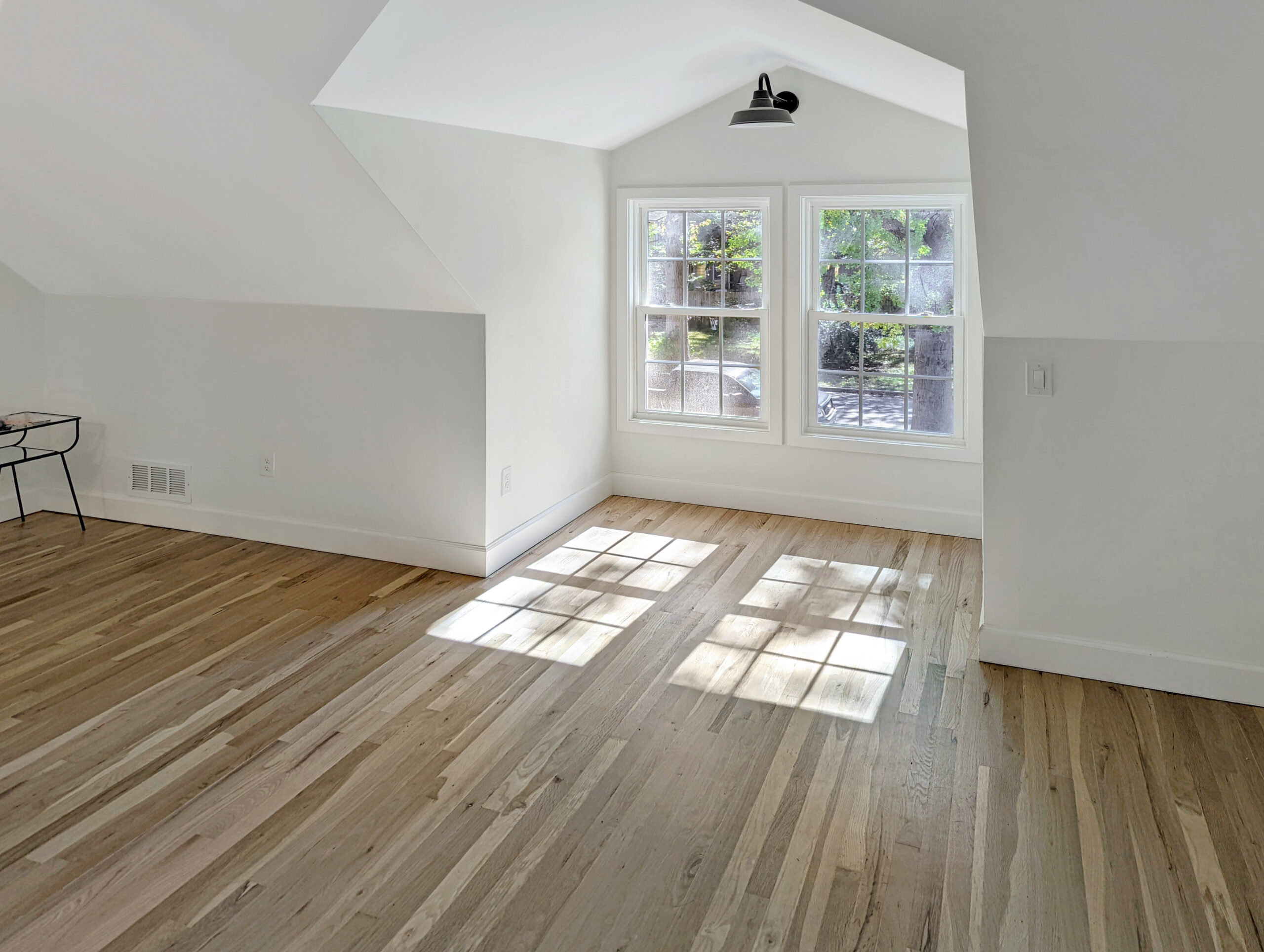
The most common regret we hear comes from homeowners who did the floors, lived with the carpeted stairs for a year, then came back to them. By that point the match is harder, mobilization is being paid twice, and the floor has ambered slightly with light while the new treads have not. Doing both in one visit is cheaper and a better result — our Kansas City hardwood refinishing guide walks through the matte, satin and semi-gloss decision that goes with it.
Two smaller choices people underestimate. Risers can be painted white or stained; painted white is the more common call in this market, reads brighter in a stairwell that usually has no window, and hides shoe scuffs far better. And species matters more on stairs than on floors, because a tread is thick solid stock that shows end grain at the nosing — our comparison of engineered versus solid hardwood is a useful starting point, with the caveat that treads are solid regardless of what the floor is.
Squeaks, Cupped Treads, and the Prep Nobody Quotes
A staircase is the one place in a house where the structure and the finished surface are the same piece of wood. On a floor, a bad subfloor gets corrected underneath and nobody sees it. On a stair, the tread is the structure — which is why prep here matters more and gets left off quotes more. Here is what a thorough crew does once the carpet is off.
Every tread gets walked and checked for movement
Squeaks come from a tread moving against a stringer or riser. They are trivial to fix while the stair is open and nearly impossible to fix well afterward — the strongest argument for full replacement in a house where the stairs already talk to you. Carpet has been muffling it for thirty years; wood will not.
Treads get checked for cup and slope, not assumed flat
Stock that has carried traffic since the Eisenhower administration is often cupped across its width or sloped front to back. A cap glued to a sloped tread produces a sloped finished step. Correcting it means shimming or replacing — real work that belongs on the estimate as its own line.
Riser heights get measured against each other
Adding material on top raises treads, changing the height of the bottom and top risers relative to the rest. Code generally allows only about three-eighths of an inch of variation between risers in one flight — a genuine trip-hazard limit, not a technicality. The International Code Council publishes the residential stair provisions most Kansas and Missouri jurisdictions adopt.
The edges the carpet was hiding get dealt with
Where carpet wrapped a stair, the drywall, skirt board and wall meet in a joint nobody ever finished. Wood exposes all of it. Scribing a skirt board or adding a cove molding is normal finish work — but it is work, and it is a common reason a quote grows after day one if nobody looked for it.
If the staircase runs down to a basement, the moisture picture changes and is worth raising at the estimate — below-grade stairs sit in a different humidity environment from the main level, which is why we recommend different materials down there. See waterproof flooring for Kansas City basements and our luxury vinyl installation work. Seasonal movement matters on wood stairs generally; our guide to hardwood floors and Kansas City humidity explains why a tread installed in a dry January behaves differently from one installed in July.
Open Sides, Landings, and the Details That Move the Number
Two staircases with the same step count can differ by more than a thousand dollars, and it is almost always one of these five things.
- Closed versus open stringer. A closed stair has walls both sides and no visible tread ends — the simplest, cheapest case. An open side means every tread end is on display and needs a mitered return, a small wrapped piece hiding end grain. Returns are slow, skilled work and the most common single reason a stair quote runs higher than expected.
- Winders and pie steps. Wedge-shaped treads that turn a corner instead of a landing. Each is a custom template and cut; three winders can cost what six straight steps do.
- Landings. A landing is floor, not stair — measured in square feet and priced accordingly, which is good news, because floor rates per square foot are lower than stair rates per step.
- Skirt boards. The angled trim running up the wall alongside the stair often needs scribing or replacing once the finished tread height changes.
- Railing, balusters and newel post. A different trade entirely. If your balusters currently die into a carpeted tread, replacing that tread means they come out and get reset — a real cost with nothing to do with the wood and everything to do with sequencing.

None of this is a reason to be talked out of an open staircase — it is usually the best-looking part of the house once it is done. It is a reason to make sure your estimate names it. A quote that does not distinguish open steps from closed ones has not been measured carefully enough to trust.
Kids, Dogs, and Everyone Who Uses the Handrail
Wood is more slippery than carpet. Worth saying plainly rather than talking around, because it is the honest trade for the look, the easier cleaning, and the fact that a wood tread does not hold twenty years of what a carpeted one holds. The ways to manage it stack, and none require giving up the wood:
- Sheen. Matte or satin reads less slick than gloss and hides dust, paw prints and the daily traffic line far better. On stairs we steer almost everyone away from semi-gloss.
- A runner. Held with a proper rod or purpose-made tape, it grips the part of the tread people actually step on while leaving finished wood visible either side — and it is the easiest thing to change later.
- Nosing profile. A square or lightly eased front edge gives more underfoot purchase than a heavily rounded bullnose, and reads more current besides.
- The handrail. More important than any finish decision. A rail that runs the full flight and is genuinely graspable does more for safety than everything else here combined.
If your household includes a large dog, a toddler on the move, or a parent whose balance or vision has changed, plan the runner in from the start rather than adding it later as a repair. Our guides to pet-friendly flooring in Kansas City and aging-in-place flooring go deeper on both — and the staircase is where those two sets of priorities most often meet in the same house.
Living in the House While Your Only Staircase Is Being Rebuilt
This is the question homeowners think about most and ask about least. Most Kansas City houses have exactly one staircase to the upper floor, and the bedrooms are up it.
A single straight flight typically takes two to four working days with prefinished treads, longer when treads are finished on site because each coat needs to cure. The work itself does not close the stairs — treads are commonly installed on alternating steps so there is always a safe foot placement, or the flight is done in halves. What genuinely closes a staircase is wet finish: expect to stay off it for most of a day per coat, and plan an overnight where a final coat is involved.
Things worth settling before the crew arrives:
- Which night, if any, the stairs are fully out of service — and whether anyone needs to sleep downstairs.
- Where pets and small children will be while treads are open and finish is curing. A baby gate at the top is not enough once treads are off.
- How dust is contained. Sanding treads makes fine dust in the middle of the house, where air moves most between floors.
- Whether the railing is coming off, and who puts it back.
We can usually start within about a week of an approved estimate, and stairs are frequently scheduled as the second half of a floor project rather than a separate visit — cheaper for you, and the reason the color matches. You can see finished work on our recent projects page.
Hardwood Stairs Across the Five Cities We Serve
Housing stock varies enough across Johnson County that the staircase question has a different default answer depending on which of our five cities you live in.
Prairie Village
Postwar Cape Cods and ranches, mostly late 1950s. Oak floors below, construction-grade stairs above — usually new treads over a sound structure. See our Prairie Village flooring guide.
Overland Park
Larger 1980s and 1990s two-storys with open, curved or split staircases. Mitered returns and winders are common, so step count alone will not tell you the price.
Lenexa
Newer construction with plywood or fingerjointed treads and frequently a squeak already developed. Full replacement pays for itself here more often than elsewhere.
Shawnee
Older ranches east of Nieman Road, with a genuine chance of original wood treads under the carpet. Always worth lifting a corner before assuming replacement.
Olathe
Newer two-storys where the staircase was never meant to be seen. New treads and risers over the existing carriage, color-matched to the floor below.
Split-Levels Across Johnson County
Short flights, often two or three of them, sometimes with a basement run in a different moisture environment. Priced per flight rather than as one staircase.
We work in five Johnson County cities — the full list is on our areas we serve page. Our installers are certified through the National Wood Flooring Association, and every installation carries our 1-Year Workmanship Warranty. The full scope of what we do is on our hardwood flooring installation and refinishing page, and where a staircase is part of a wider project touching wet areas, our custom tile installation work often runs alongside it.