
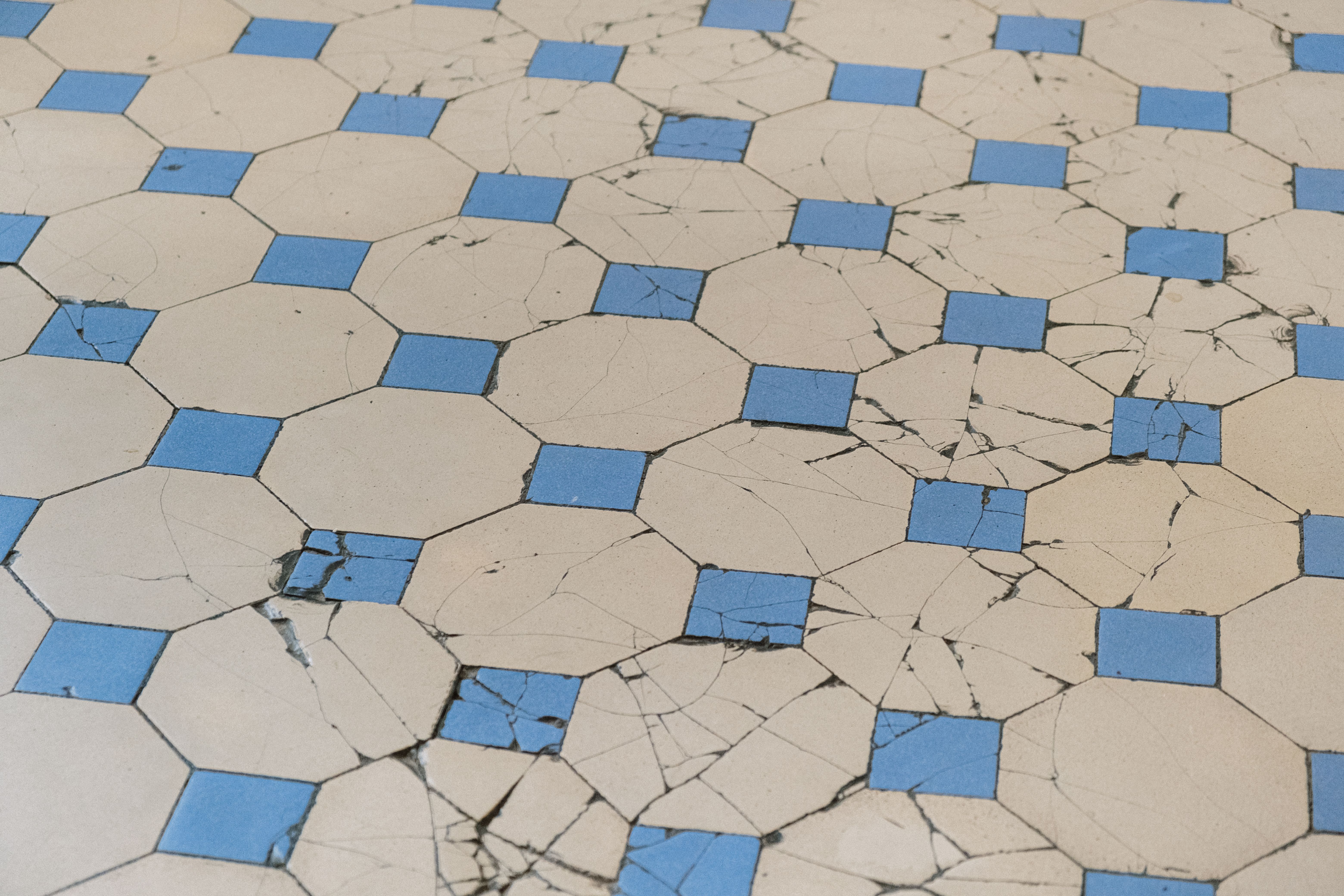
Start With the Symptom, Not the Solution
Most homeowners come at a tile problem from the wrong end. They decide the floor needs regrouting, or that the whole thing has to go, before working out what is actually happening underneath it. Tile is a rigid surface sitting on top of things that move — concrete, plywood, joists, mortar — and nearly every visible failure is that movement showing through.
So the first useful step is translation. Each symptom points at a different layer of the assembly, and each layer costs a very different amount to fix.
| What You See or Hear | What It Usually Means | Which Layer | Urgency |
|---|---|---|---|
| Hairline cracks in a few joints | Ordinary wear, shrinkage, or a joint that was overworked when it was installed | Grout only | Low |
| Grout gone around the room perimeter | Missing or filled movement joint — the floor has nowhere to expand | Grout + layout | Medium |
| Grout cracked in one continuous line | A joist, a subfloor seam, or a slab crack moving below | Substrate | High |
| Hollow sound under a few tiles | Voids in the mortar bed, either original or newly debonded | Bond coat | Medium |
| A tile that rocks or clicks | Bond fully broken; the tile is loose in its opening | Bond coat | High |
| Tiles cracked in a straight line | Deflection or a substrate crack telegraphing upward | Structure | High |
| Tile edges lifted or tented | Compressive stress with no expansion relief anywhere | Structure + layout | High |
| Dark, damp or musty grout near a fixture | Water passing the surface and sitting in the substrate | Waterproofing | Urgent |
Notice how little of that list is about the tile itself. Porcelain and ceramic are extremely hard materials and they rarely fail on their own merits. When a Kansas City tile floor goes bad, the tile is usually just the messenger.
The 20-Minute Walk-Through You Can Do This Weekend
You need a quarter, a butter knife, a flashlight and a roll of painter's tape. Work one room at a time and mark what you find directly on the floor with tape. A photo of a taped-up floor is worth more at an estimate appointment than any description you can give over the phone.
Tap the Whole Field With a Coin
Tap a quarter across every tile, working in rows so you do not skip any. Solid tile gives a dull, tight click. A void underneath gives a higher, drummier sound, and once you have heard the difference you cannot unhear it. Tape an X on every hollow tile. What you are mapping is not just how many there are, but whether they cluster: a scatter of hollow tiles across a room is a very different problem from a hollow patch four feet wide.
Put Weight on Each Edge
Kneel and press hard on one corner of a suspect tile, then the opposite corner. Movement you can feel, a click, or grout dust puffing out of the joint means the bond is broken, not merely voided. A tile that visibly rocks is the most actionable finding on this list, because it will keep working at its neighbors and at the grout around it until someone stops it.
Probe the Cracked Joints
Run the tip of a butter knife along any cracked grout. If it skates over a hairline and nothing comes out, that is surface crazing. If grout crumbles out in chunks, or the blade drops in more than a millimeter or two, the joint has failed through its depth and water has a path down. Note which joints are soft rather than how many — the pattern is the diagnosis.
Look for a Line
Stand at one end of the room, get your eye low and shine a flashlight almost flat across the tile. Raking light exposes what overhead light hides: continuous cracks, high edges, dips and cupping. If the damage lines up across several tiles, especially running the same direction as the floor joists, you have found structural movement rather than a tile problem.
Check the Edges of the Room
Pry a piece of shoe molding loose in an inconspicuous corner and look behind it. Tile set tight to the wall with grout packed into the gap has no room to expand. Floors that cannot expand relieve that stress somewhere else, usually as a cracked line through the middle of the field or a tented row at a doorway.
Test the Wet Spots
Around toilets, tub aprons, the dishwasher bay, the refrigerator water line and the base of a shower curb, feel for grout that stays damp, reads darker than the field, or smells musty. Press on the tile directly in front of a toilet: any give at all there deserves attention immediately, because by the time a slow leak reaches the tile it has usually been in the subfloor for months.
Bounce the Span
Walk heavily across the middle of the room, away from the walls, and watch a glass of water sitting on the tile. Visible ripple, or a rattle from a nearby cabinet door, means the floor system is flexing. Tile has almost no tolerance for that. On a basement slab you will not see any movement at all, which is its own useful information: down there, a cracked line almost always traces a crack in the concrete.
Twenty minutes of this puts you ahead of most homeowners and ahead of a fair number of quotes. It also changes the conversation from "the tile looks bad" to "eleven hollow tiles clustered in front of the sink, one continuous crack running the length of the room, and soft grout at the dishwasher." Those are two entirely different appointments.
What Cracked Grout Is Actually Telling You
Grout is the most misunderstood part of a tile floor. It is a filler, not an adhesive. It keeps debris out of the joints, stabilizes tile edges against each other and finishes the look, but it is not what holds your floor down. That is why cracked grout is sometimes trivial and sometimes the first visible sign of something expensive — and why the location of the cracks tells you which one you have.
Cracks Scattered Through the Field
A hairline here and there, usually in the busiest walking lane, is normal aging. Grout is cement-based and it shrinks slightly as it cures; joints that were tooled a little too wet or a little too dry crack first. If the tiles around those joints are solid to a coin tap and nothing rocks, this is maintenance. Grind out the failed joints, refill, and reseal.
Cracks in One Continuous Line
This is the one to take seriously. Grout that fails along a single line across a room is following something: a joist below, a seam between two sheets of subfloor, or a crack in a slab. Every seasonal cycle, that line opens and closes a fraction of a millimeter, and the grout has no ability to stretch. Refilling it makes the floor look right for a season or two and then the same joint opens again. The fix lives under the tile, not in it.
Cracks Around the Perimeter and at Doorways
Tile expands and contracts with temperature and moisture, and every properly installed floor gets a gap at the walls, at columns, at thresholds, and at intervals in large open runs. Those gaps are supposed to be filled with flexible sealant, hidden behind baseboard or shoe molding — never with rigid grout. When they are grouted solid, or when a wide open floor has no relief joints at all, the floor eventually finds its own relief: cracked grout, then cracked tiles, then in the worst cases a row of tile that lifts off the substrate entirely.
Cracks at Inside Corners and Against Fixtures
Where the floor meets a tub, a shower curb, a cabinet toe kick, or a wall, two different planes move independently. Those junctions are caulk joints by design. Grout in a change of plane cracks reliably within a year or two, and homeowners regrout them repeatedly wondering why it never lasts. It never lasts because it was the wrong material for that joint.
Grout That Is Soft, Dark or Sandy
Grout that crumbles under a fingernail, stays darker than the surrounding field after the floor has been dry for days, or has a faint musty smell is a moisture finding rather than a wear finding. Water is getting in and not getting back out. In a bathroom, that usually means a failed caulk joint or a bad seal at the toilet flange. Fixing the grout without fixing the water source just hides the evidence.
Hollow Spots and Loose Tiles: Bond Failure in Slow Motion
A hollow sound means air where mortar should be. The tile is bridging a void instead of resting in a full bed, and it is carrying loads it was never meant to carry alone. That can be original workmanship or progressive failure, and the difference determines what happens next.
Tile is set in thin-set mortar that is combed out with a notched trowel and then compressed as the tile is pressed and beaten in. Done well, the ridges collapse into a nearly continuous bed. The trade benchmark is roughly 80 percent mortar coverage in dry interior areas and 95 percent in wet areas such as showers and floors that see standing water, with full support at every corner. Fall short of that and you get voids, and voids are where cracks start when something heavy lands or a chair leg concentrates a load.
Here is how to interpret what your coin found:
- A few isolated hollow tiles, no movement — likely original coverage gaps. Many floors live full lives this way. Keep the map you taped, retest in six months, and see if anything changed.
- Hollow tiles clustered in one area — something local happened: a leak, a heavy appliance, a spot where the substrate was never flat. Worth investigating before it spreads.
- Hollow along a line or an edge — movement below. This is the same diagnosis as a continuous grout crack, just heard instead of seen.
- Hollow and rocking — the bond is gone. That tile is now a small hammer, working on its own grout and on the tiles beside it every time someone walks past.
- Hollow and growing — the finding that matters most. If the taped area is bigger than it was last spring, the floor is actively failing and a patch is a stopgap.
Loose tiles also have a habit of turning into cracked tiles. Once a tile can flex, its unsupported center is the weak point, and porcelain does not bend. That is why a single rocking tile in a kitchen walkway is worth pulling and resetting now rather than after Thanksgiving: the repair is one tile in October and four tiles plus a grout color match in December.
One caution on matching. If your tile is more than five or six years old, the exact line may be discontinued, and dye lots vary even when it is not. Check whether you have leftover boxes in the basement or garage before anyone starts demo. If you do not, an installer can often pull replacement tiles from a closet or under an appliance where the color break will never be seen and use those in the visible field.
Not Sure Whether It Is Grout or the Subfloor?
That is exactly the question a free in-home estimate answers. We tap the field, check the joints and the wet areas, look at what is under the tile where we can, and tell you plainly whether you are buying a repair, a section, or a new floor — with the prep and the tile priced as separate lines.
Get My Free EstimateWhy Tile Fails in Kansas City Houses Specifically
Tile assemblies fail for the same handful of reasons everywhere, but our housing stock and our weather push on a few of them harder than most.
A Wood Floor That Flexes More Than Tile Allows
The industry benchmark is that a floor system should deflect no more than its span divided by 360 under load for ceramic and porcelain, and no more than span over 720 for natural stone. Plenty of older Kansas City homes — the pre-war four-squares, the older Shawnee ranches, anything with long joist spans and a single layer of subfloor — were never framed with tile in mind. Tile went down during a 1990s remodel over a floor that was fine for oak and marginal for porcelain, and it worked until the day it did not. This is also why the same tile can perform beautifully in one room of a house and crack in the next.
Slabs That Crack, and Tile Bonded Directly to Them
Below grade, concrete moves and cracks. That is not a defect; it is what concrete does. The defect is bonding tile rigidly to a slab with nothing in between. An uncoupling or crack-isolation membrane sits between the slab and the tile and lets the two move independently, which is why the same basement floor can survive a hairline slab crack with a membrane and telegraph it straight through the tile without one. If you are looking at a basement bath or a finished basement floor with a crack running wall to wall, this is almost always the story.
Our Humidity Swing
Kansas City runs humid through July and August and then dries out sharply once the furnaces come on in October. Framing, subfloor and tile all respond to that at different rates, which is exactly why fall is when homeowners notice new cracks. The floor did not necessarily fail in the last week. The seasonal change just moved everything enough to make the existing problem visible. The same mechanism drives the seasonal gapping people see in wood floors, which we walk through in our guide on hardwood floors and Kansas City humidity.
Prep That Got Skipped
Substrate flatness, the right backer board or membrane, full mortar coverage, movement joints, and correct cure time are all invisible in a finished floor and all decisive in how long it lasts. They are also the first things to disappear when a job gets priced to the bottom. When we quote a tile floor we price prep as its own line — subfloor repair and leveling runs $2 to $25 per square foot across only the areas that need it — because a number that hides the prep is a number that will change once demo starts.
Water Where It Was Never Waterproofed
Tile is water resistant. A tile assembly is only waterproof if someone made it that way. In wet areas we build with membrane systems such as RedGard or Schluter behind and beneath the tile, which is standard practice in every shower we install through our custom tile installation work. A shower without that layer keeps water out for years on grout and caulk alone, and then it does not, and the damage is behind the wall by the time anyone sees a symptom.
Repair, Patch a Section, or Start Over
Once you know what is wrong, there are only three honest paths. The right one is decided by whether the movement underneath has stopped, not by how bad the floor looks.
Targeted Repair
Right When
- Cracks are scattered hairlines, not a line
- Nothing rocks and hollow tiles are isolated
- Damage is limited to a handful of tiles
- Perimeter and corner joints need caulk, not grout
- You have leftover tile or a hidden donor area
Watch For
- Grout color rarely matches perfectly on an aged floor
- Regrouting a moving floor fails again in a season
- New grout darkens the contrast until everything ages in
Typical scope: a short visit to a day. Grind and refill failed joints, reset or replace individual tiles, convert change-of-plane joints to flexible sealant, reseal.
Section Replacement
Right When
- Failure is concentrated in one identifiable area
- A leak has been found and fixed at the source
- The subfloor under that area needs repair
- The rest of the field taps solid everywhere
- You can still get matching tile
Watch For
- Dye lots differ even within the same product line
- Opening a floor sometimes reveals more wet subfloor
- A patched section is visible in raking light
Typical scope: demo the affected area, repair or level the substrate at $2–$25/sq ft on the areas that need it, then reset tile and blend the grout.
New Floor
Right When
- Cracks or hollow areas run in lines across the room
- Hollow mapping keeps growing year over year
- The subfloor or slab needs work under most of the field
- Tile is discontinued and repairs would be obvious
- You were going to change the tile anyway
Watch For
- The room is out of service for the duration
- Prep, not tile, is the number that moves
- Complex patterns and mosaics cost more to set
Typical scope: $5–$8/sq ft for standard tile installation labor, $10–$15/sq ft for complex patterns and mosaics, plus material. See our full pricing.
For planning purposes, all-in tile numbers in the Kansas City metro tend to land around $8 per square foot for ceramic with a standard installation, $12 for porcelain, roughly $18 for premium porcelain in a complex pattern, and about $22 per square foot for a shower or backsplash with full waterproofing. Those are honest middles, not teaser rates, and the one line that can move them meaningfully is what we find under the old floor.
It is also worth asking whether tile is still the right material for that specific room. Tile earns its keep in bathrooms, mudrooms, entries and anywhere water sits, and our guide to bathroom tile in Kansas City covers how to spec it. But a basement rec room that has cracked twice over a moving slab, or a laundry room where the goal is simply a waterproof floor by November, is often a better fit for rigid-core luxury vinyl. If you are weighing that trade, our room-by-room comparison of luxury vinyl and hardwood lays out where each material genuinely wins, and if the answer is wood in the adjoining living space, the real cost per square foot of hardwood installation is broken down there too.
The Before-Guests Timeline, Working Backward From November
The reason to run the walk-through in late August rather than the week before company arrives is not urgency for its own sake. It is that tile work has fixed steps that do not compress: demolition, substrate repair, setting, cure, grout, cure again. Rushing any of them is how a new floor becomes next year's problem.
| When | What Happens | Why It Matters |
|---|---|---|
| Late August – early September | Walk-through, tape the findings, book an estimate | Diagnosis before demo is what keeps the quote honest |
| Mid September | Scope confirmed, tile selected, material ordered | In-stock product ships in days; special order can take weeks |
| Late September – October | Demo, subfloor repair, membrane, set, grout | Floors typically take 2–4 days; backsplashes 1–2 days |
| The days right after | Mortar and grout cure, sealer applied, trim reset | Cure time is not padding — showers need the most of it |
| November | Floor is in service well before anyone arrives | No plastic sheeting in the photos |
If you are reading this in November instead, triage rather than remodel. Have a rocking tile reset so nobody catches a toe on it, convert the cracked perimeter and corner joints to flexible sealant so they stop opening, and put a runner over a cosmetic crack. Then book the real work for January, when schedules open up and nobody needs the guest bath the same week.
Two things are worth doing regardless of timing. Reseal grout in high-moisture rooms about once a year, which is cheap insurance against exactly the water intrusion that turns a grout problem into a subfloor problem. And keep a labeled box of leftover tile somewhere dry, because a matching tile in the basement is the difference between a one-hour repair and a whole-room conversation.